

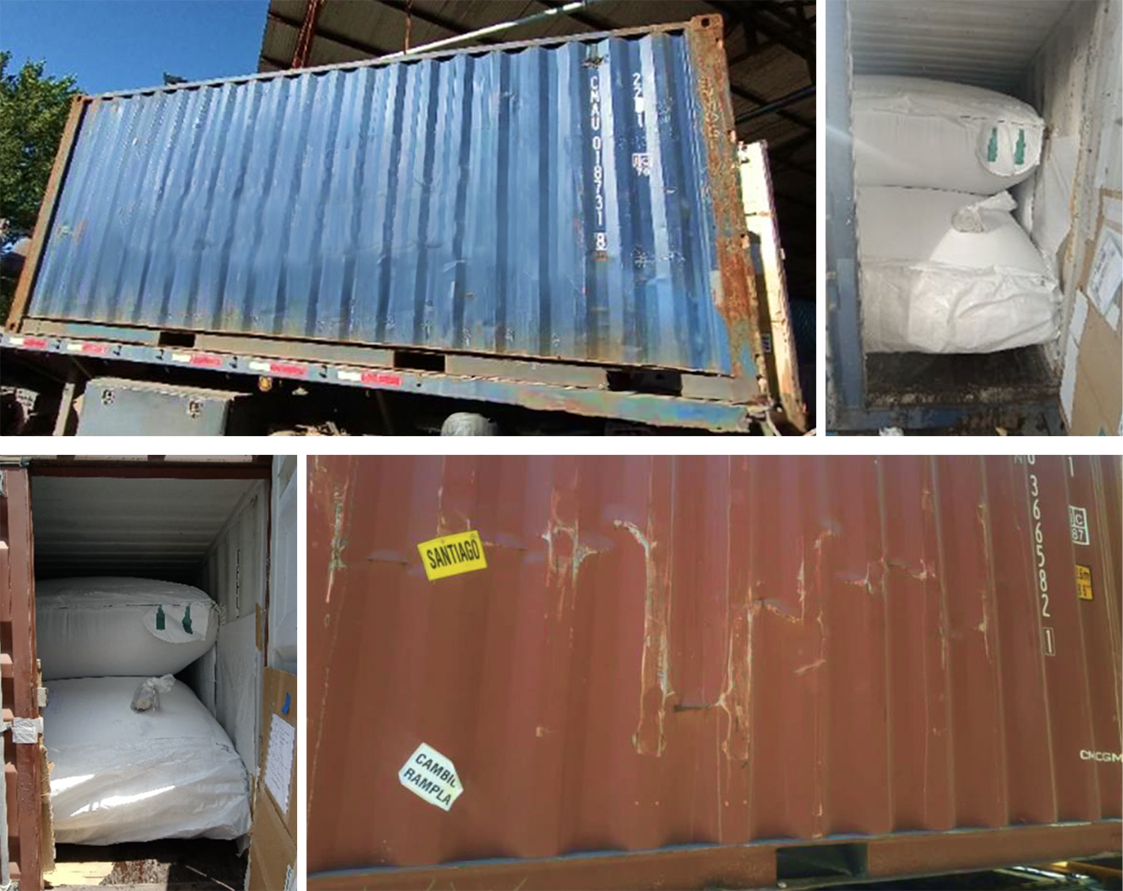
In bulk liquid transport, flexitanks are widely used for products like sunflower oil, soybean oil, olive oil, palm oil, avocado oil, fish oil, and canola oil.
But there is one issue the industry quietly accepts:
• container side wall bulging
The truth is simple.
Conventional flexitanks always bulge.
Sometimes a little, sometimes a lot — but never zero.
That’s why operators are forced to use only A-grade containers, which already limits flexibility.
The problem gets worse at higher volumes. Especially for 26,000 L loadings, the pressure on container walls increases significantly. Some try to solve this with metal support bars.
But in reality, this is not a solution.
It often leads to:
- abrasion on the flexitank
- leakage risks
- even more severe failures
• Trying to fix bulging this way can actually make things worse.
Once a container bulges, the problems don’t stay inside the container.
At ports, operations slow down.
Handling becomes difficult.
Containers are frequently rejected.
At transshipment points, things get even more complicated.
• Cross-pumping becomes necessary
This means:
- extra cost
- delays
- operational headache
And more importantly, product hygiene becomes questionable during transfer.
Even though products like sunflower oil, soybean oil, olive oil, palm oil, avocado oil, fish oil, and canola oil are not classified as dangerous goods, the situation has changed.
Because of these recurring issues, international logistics organizations now describe them as:
• “cargoes of concern”
Insurance and risk management bodies such as TT Club are also taking this issue very seriously.
TT Club has published detailed best-practice guidelines for flexitank operations, specifically addressing the risks associated with container damage, improper installation, and handling procedures.
• The message is clear:
Conventional flexitank-related risks are not theoretical — they are operational realities that must be actively managed.
So the real question is no longer whether flexitanks are useful.
• The real question is: can they operate without bulging?
This is exactly where LiquA makes the difference.
LiquA does not try to control or reduce container bulging — it is engineered to eliminate it at the source. The 27,000 L Jumbo E-Flex is designed with a different load distribution logic, allowing the pressure inside the container to be managed in a controlled and balanced way.
Instead of forcing the container side walls to absorb the stress, the system works with the container geometry—preventing deformation rather than reacting to it.
• No side wall bulging
• No limitation for container selection. A, B, and C class containers can be safely used.
• No cross-pumping at the transshipment ports.
• No need for support bars
• No abrasion risks
• No compromise on safety
The result is not just a better flexitank, but a more stable and predictable operation.
No unexpected port issues.
No cross-pumping at transshipment.
No delays caused by container rejection.
And this performance is not dependent on luck or ideal conditions — it is supported by LiquA’s operational control.
With a presence in over 50 countries, including its own companies in key locations, LiquA ensures that every installation, loading, and discharge is handled correctly.
Because in reality, eliminating bulging is not just about design.
• It is about combining the right technology with the right execution.

